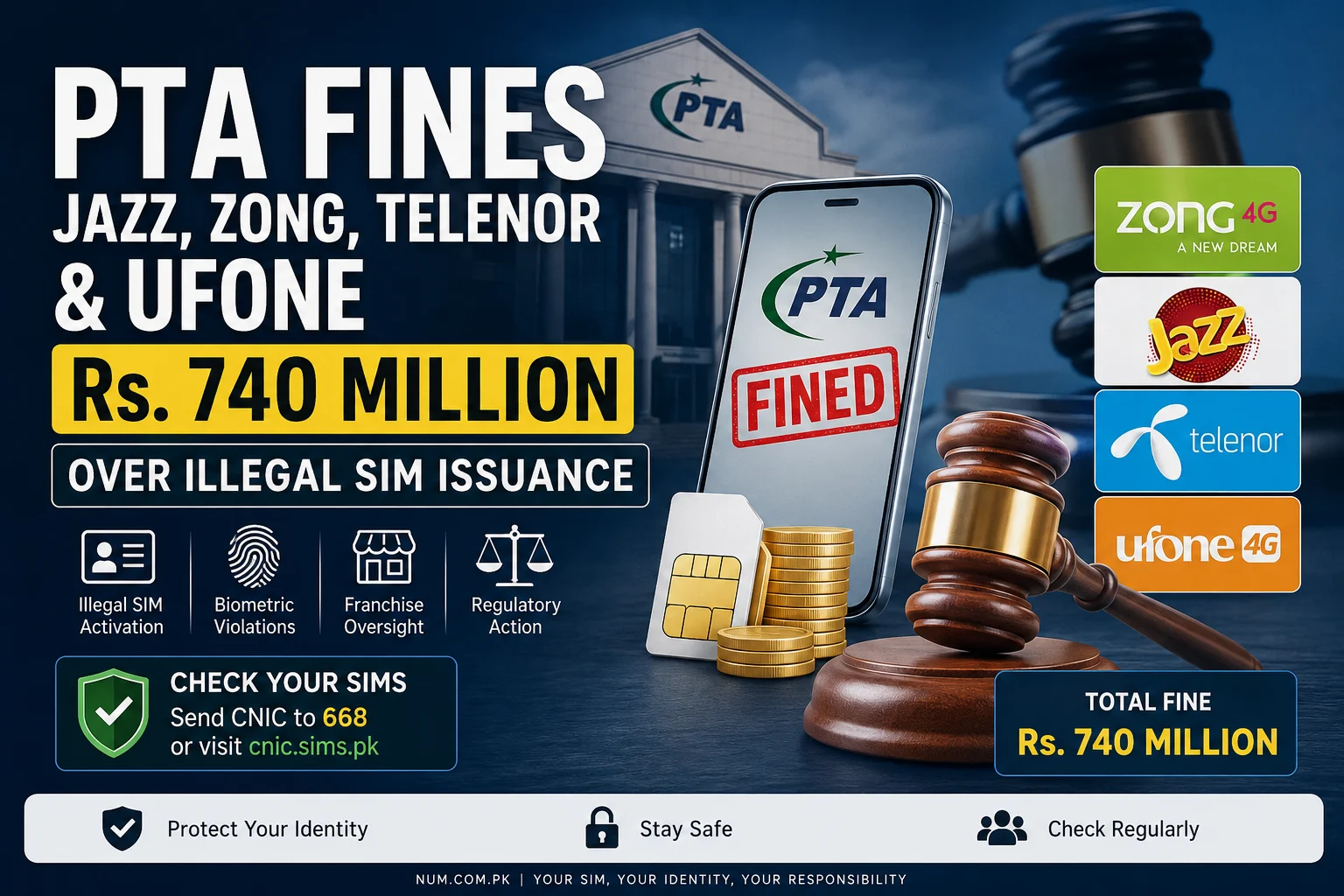
PTA Penalises All Four Operators Over Illegal SIM Issuance (July 2026)
The Pakistan Telecommunication Authority (PTA) has taken strict action against all four major mobile operators in the country. On July 15, 2026, PTA imposed a combined fine of Rs 740 million on Jazz, Zong, Telenor, and Ufone. The reason is simple but serious: these companies issued SIM cards on people’s CNICs without their knowledge or permission. In many cases, citizens had no idea a new SIM was even activated in their name. This has raised real concerns about identity theft, financial fraud, and weak biometric checks at franchise shops. In this article, we break down exactly why PTA took this action, how much each operator was fined, what the violations were, and how you can check if an unknown SIM is registered against your own CNIC right now.
Why Did PTA Fine All Four Mobile Operators?
PTA found that SIMs were being activated against people’s CNICs without their consent. This happened through authorized franchise shops in different cities. In several cases, the person whose CNIC was used never visited the shop and never agreed to get a new SIM.
PTA said this is not a small mistake. It called illegal SIM issuance a serious security risk. Fake or unauthorized SIMs can be used for:
- Cyber fraud
- Identity theft
- Financial scams
- Misuse of Pakistan’s telecom network
The action was taken under Section 23 of the Pakistan Telecommunication (Re-organization) Act, 1996, which gives PTA the power to penalize operators for regulatory violations.
How Much Fine Did Each Operator Pay?
PTA has taken action against all four major mobile operators over SIM-related and other regulatory violations. Ufone received the highest fine of Rs. 233.4 million. Zong was fined Rs. 155.6 million for breaking SIM issuance rules. Jazz and Telenor were each fined Rs. 116.7 million for regulatory violations.
| Operator | Fine | Reason |
| Ufone | Rs. 233,400,000 | Multiple regulatory violations |
| Zong | Rs. 155,600,000 | SIM issuance rule violations |
| Jazz | Rs. 116,700,000 | Illegal SIM issuance and poor franchise oversight |
| Telenor | Rs. 116,700,000 | SIM registration rule violations |
| Total | Rs. 740,000,000 | Total fine against all four operators |
The Zong Case: A Clear Example of the Problem
One case stands out because it shows exactly how these violations happen. PTA found that China Mobile Pakistan Zong had activated a SIM against a subscriber’s CNIC through an authorized franchise in Lahore – without the subscriber ever knowing about it.
When PTA raided the franchise, it recovered:
- Laptops used for SIM registration
- Biometric verification devices
- Around 150 SIM cards
Zong argued that the SIM had passed NADRA biometric verification, so it should not be blamed. PTA rejected this defense. The regulator ruled that passing a biometric scan does not automatically mean the SIM was issued lawfully. Operators are still responsible for making sure the subscriber actually agreed to get the SIM.
This case shows why PTA is treating this issue so seriously – biometric checks alone are not enough to stop fraud if the person behind the counter is misusing the system.
Telenor Case Highlights
- PTA found a SIM activated using a customer’s CNIC without her permission.
- The SIM was issued through an authorised Telenor franchise.
- PTA recovered biometric devices, laptops, and SIM cards from the franchise.
- The equipment was linked to unauthorised SIM activations.
- PTA said operators are responsible for the actions of their franchises.
- Operators cannot avoid responsibility by calling franchises independent businesses.
Ufone Faced Major SIM Violations
- Ufone received the highest fine among the four operators.
- PTA found several cases of illegal SIM issuance.
- More than 12,600 active SIMs were recovered during one raid.
- Authorities also found biometric devices and other equipment.
- Some SIMs were issued without customer permission.
- The violations were linked to Ufone franchises in different cities.
Jazz Fined for Regulatory Violations
- PTA fined Jazz Rs. 116.7 million.
- The fine was related to SIM issuance and biometric verification violations.
- Jazz did not fully follow the required SIM registration procedures.
- The violations involved customer verification through biometric systems.
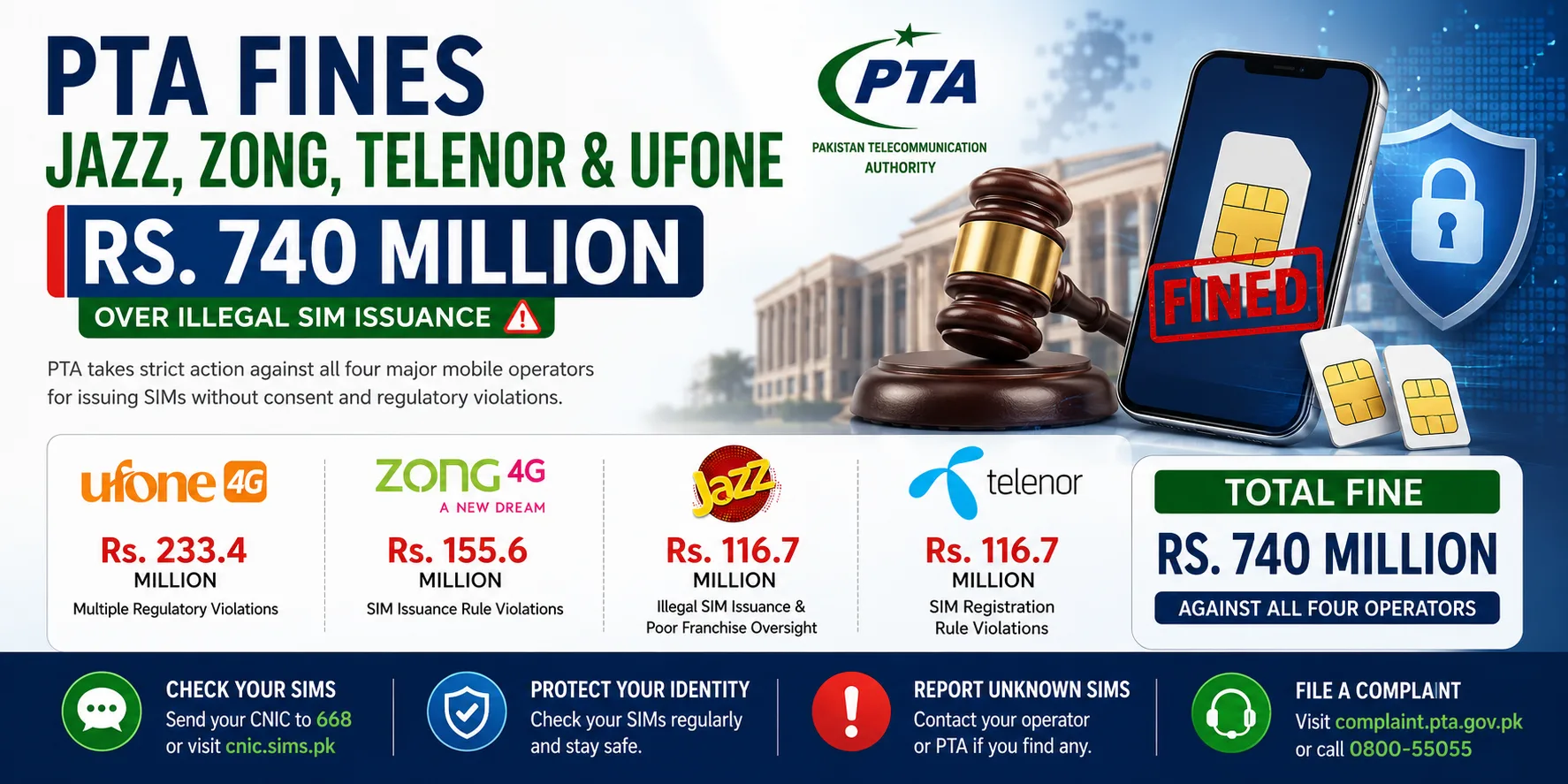
How Much Was Each Operator Fined?
PTA fined all four major mobile operators for different regulatory violations. The fines were:
- Zong: Rs. 155.6 million
- Jazz: Rs. 116.7 million
- Telenor: Rs. 116.7 million
- Ufone: Rs. 116.7 million
- Ufone additional fines: Rs. 77.8 million and Rs. 38.9 million in separate cases
The total fines against the four operators came to around Rs. 740 million.
What Went Wrong at the Franchise Level?
PTA’s investigation pointed to several common problems across all four operators:
- No Live Finger Detection at many franchise points, making it easier for fake fingerprints or stored prints to pass verification
- No geofencing, meaning SIMs could be activated from locations far from where the customer actually was
- Weak monitoring of franchise partners by the main operators
- Bulk SIM activation without proper individual consent checks
PTA made it clear that operators cannot blame their franchise partners alone. Under telecom rules, the main operator is responsible for what happens through its authorized dealers.
What Happens If Operators Don’t Pay?
PTA has directed all four operators to deposit their fines within the given time period. If any operator fails to comply, PTA has warned that it will take further legal action under the law. PTA also said this is not a one-time crackdown – it will continue strict enforcement to protect consumer data and strengthen telecom security across Pakistan.
How to Check If a SIM Is Registered Against Your CNIC
Since this news has made many people worried about their own SIMs, here is how you can check in under a minute:
668 SMS Check: Send your 13-digit CNIC number (without dashes) to 668. You will get a reply showing the total number of SIMs registered against your CNIC, along with the operator name for each one.
Online Portal: Visit PTA’s official SIM Information System at cnic.sims.pk. Enter your CNIC number, agree to the terms, and click submit. The website will show you a full list of SIMs linked to your CNIC.
If you find a SIM you don’t recognize:
- Note down the operator name and number shown in the result.
- Visit that operator’s official franchise with your original CNIC.
- Submit a written request to disown (remove) the unknown SIM.
- Recheck via 668 within 48 hours to confirm it has been removed.
- If the franchise refuses to help, file a complaint at complaint.pta.gov.pk or call the PTA helpline 0800-55055.
It’s a good habit to run this check once a month, especially if you’ve ever shared a copy of your CNIC for any reason.
Conclusion
PTA’s Rs. 740 million fine against Jazz, Zong, Telenor, and Ufone shows that telecom companies are responsible for the SIMs issued through their franchises. The cases also show that a SIM can sometimes be activated without the customer’s real permission. Simply using biometric verification may not always be enough to prevent misuse. For mobile users, the message is simple: regularly check the SIMs registered on your CNIC. If you find a SIM that you did not request, report it and get it blocked as soon as possible. You can check the SIMs linked to your CNIC through the 668 service or cnic.sims.pk. Staying alert and checking your SIM information regularly can help protect your identity and personal information.
Frequently Asked Questions (FAQs)
Why did PTA fine Jazz, Zong, Telenor, and Ufone?
PTA fined all four operators for issuing SIM cards against people’s CNICs without their knowledge or consent. The cases also involved problems with biometric verification and franchise monitoring.
Which operator received the highest fine?
Ufone received the highest total penalty, with combined fines of more than Rs. 233.4 million across multiple cases.
What law did PTA use to impose these fines?
PTA imposed the fines under Section 23 of the Pakistan Telecommunication (Re-organization) Act, 1996.
Can biometric verification alone prove that a SIM was issued legally?
No. PTA stated that passing biometric verification does not always mean a SIM was issued legally. Operators must also make sure that the customer has given genuine consent.
How can I check how many SIMs are registered on my CNIC?
Send your 13-digit CNIC number without dashes to 668, or check your SIM information online through cnic.sims.pk.
What should I do if I find an unknown SIM on my CNIC?
Visit the relevant operator’s franchise with your original CNIC and ask them to disown the SIM. Request confirmation that the SIM has been removed. You can also check again through 668 and file a complaint with PTA if needed.
Is illegal SIM issuance a common problem in Pakistan?
PTA’s investigation found repeated violations involving unauthorised SIM activations, weak franchise monitoring, and problems with biometric verification.
What happens if operators do not pay the fine?
PTA has warned that further legal action may be taken against operators that fail to pay the fines within the required time.
Disclaimer
The information provided on num.com.pk is for general informational and educational purposes only. We are an independent website and are not affiliated with, endorsed by, or officially connected with PTA, NADRA, or any mobile network operator in Pakistan. SIM, CNIC, mobile network, and telecommunications information may change over time, so users should verify important information through the relevant official or authorized sources. num.com.pk does not provide unauthorized access to private SIM databases, CNIC records, mobile-number ownership information, or live location data. We do not guarantee the completeness, accuracy, or current status of all information published on this website. By using our website, you acknowledge that you do so at your own discretion and risk.