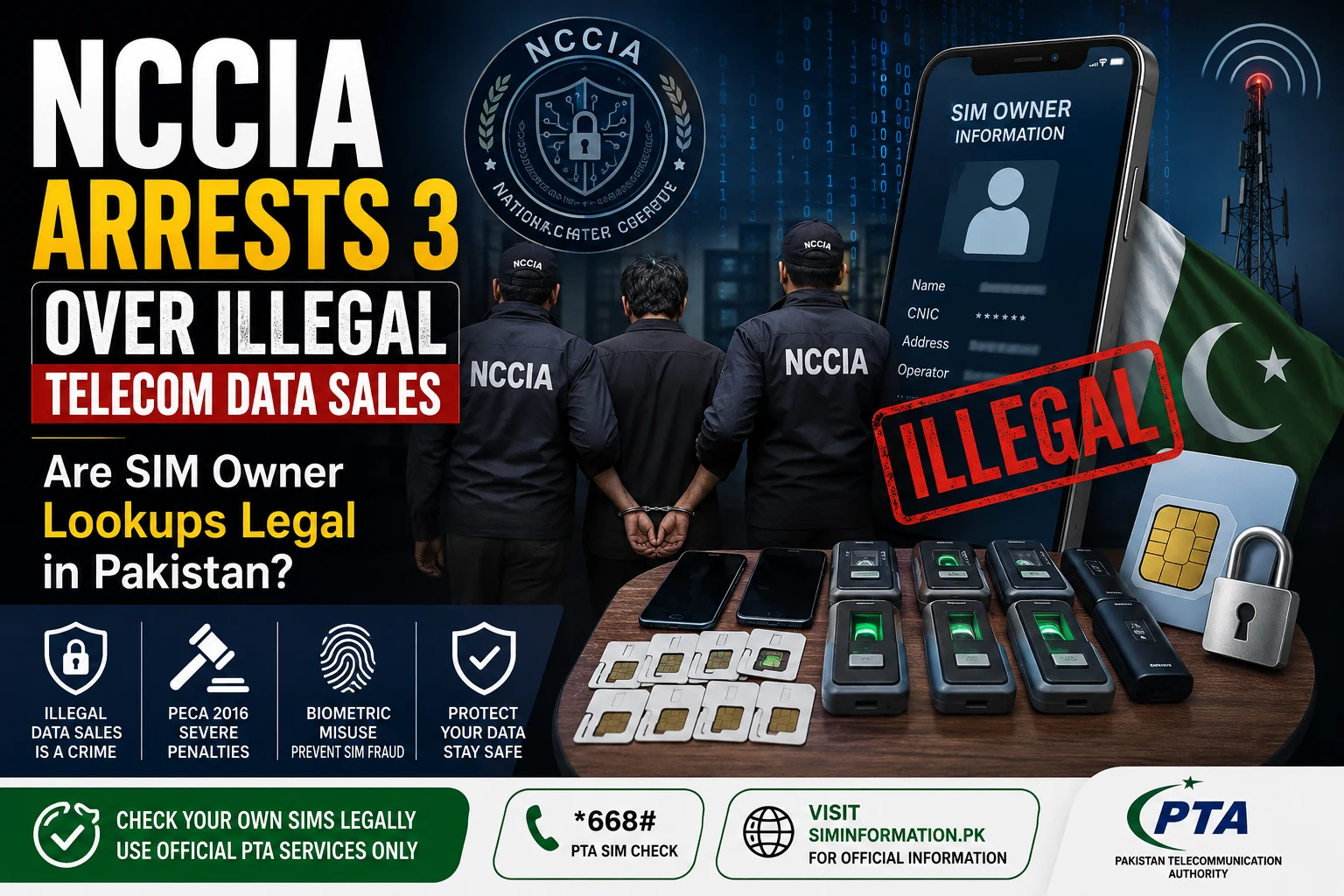
The National Cyber Crime Investigation Agency (NCCIA) has arrested three men in Lahore for allegedly running a network that illegally obtained and sold sensitive telecom subscriber data, including call records, SIM ownership details, and location data. The case has left many mobile users in Pakistan asking a simple but important question: is it actually legal to look up someone’s SIM owner details? In this article, we explain exactly what happened in the NCCIA case, what the law says about checking SIM owner information in Pakistan, and how you can check your own SIM details in a safe and legal way.
We follow PTA and NCCIA announcements closely and turn them into clear, accurate guides for everyday users. Our goal is to give you information you can rely on, based on real statements from Pakistani authorities, so you never have to guess whether a website, app, or service is actually operating within the law.
What Happened: The NCCIA Arrest Case
On July 15, 2026, the Pakistan Telecommunication Authority (PTA) Lahore zonal office filed a formal complaint with the NCCIA Lahore office about the illegal sale of confidential telecom subscriber data. The complaint covered Call Detail Records (CDRs), subscriber information, location data, and IMEI records that were allegedly being traded illegally.
Acting on this complaint, NCCIA Lahore launched an enforcement operation and arrested three suspects, identified as Muhammad Saghir, Muhammad Ashfaq, and Malik Saddham. An FIR (No. 146/2026) was registered, and the investigation is ongoing.
What Was Recovered
During the operation, NCCIA recovered the following items from the suspects:
| Item Recovered | Quantity |
| Mobile phones | 5 |
| Biometric Verification System (BVS) devices | 8 |
| Suspicious/unregistered SIM cards | 43 |
Forensic analysis of the seized phones reportedly uncovered WhatsApp conversations linked to the unauthorized sale of subscriber data. The recovered material also included fingerprint records, CNIC information, and evidence of financial transactions connected to the alleged operation.
PTA stated that protecting the personal and confidential data of consumers remains a top priority, and confirmed that legal action against anyone involved in the illegal trade of sensitive telecom information will continue.
Why the BVS Devices Matter
- The eight Biometric Verification System devices found in the suspects’ possession are significant.
- These are the same type of devices telecom outlets use to verify a person’s fingerprint against NADRA’s database before issuing a SIM card.
- In the wrong hands, this kind of device can potentially be misused to fraudulently register SIM cards using someone else’s identity, not just to resell already-stolen data.
- This is why PTA has separately introduced stricter outlet authorization rules and Live Finger Detection requirements in 2026 to make this kind of misuse harder.
Are SIM Owner Lookups Legal in Pakistan? The Straight Answer
Checking the SIM information registered on your own CNIC is completely legal. PTA provides free tools for exactly this purpose.
Checking someone else’s SIM owner details — their name, CNIC, or address — using only their phone number is illegal. There is no lawful public tool anywhere in Pakistan that allows this, and using or operating a service that offers it is a criminal offence.
What the Law Actually Says (PECA 2016)
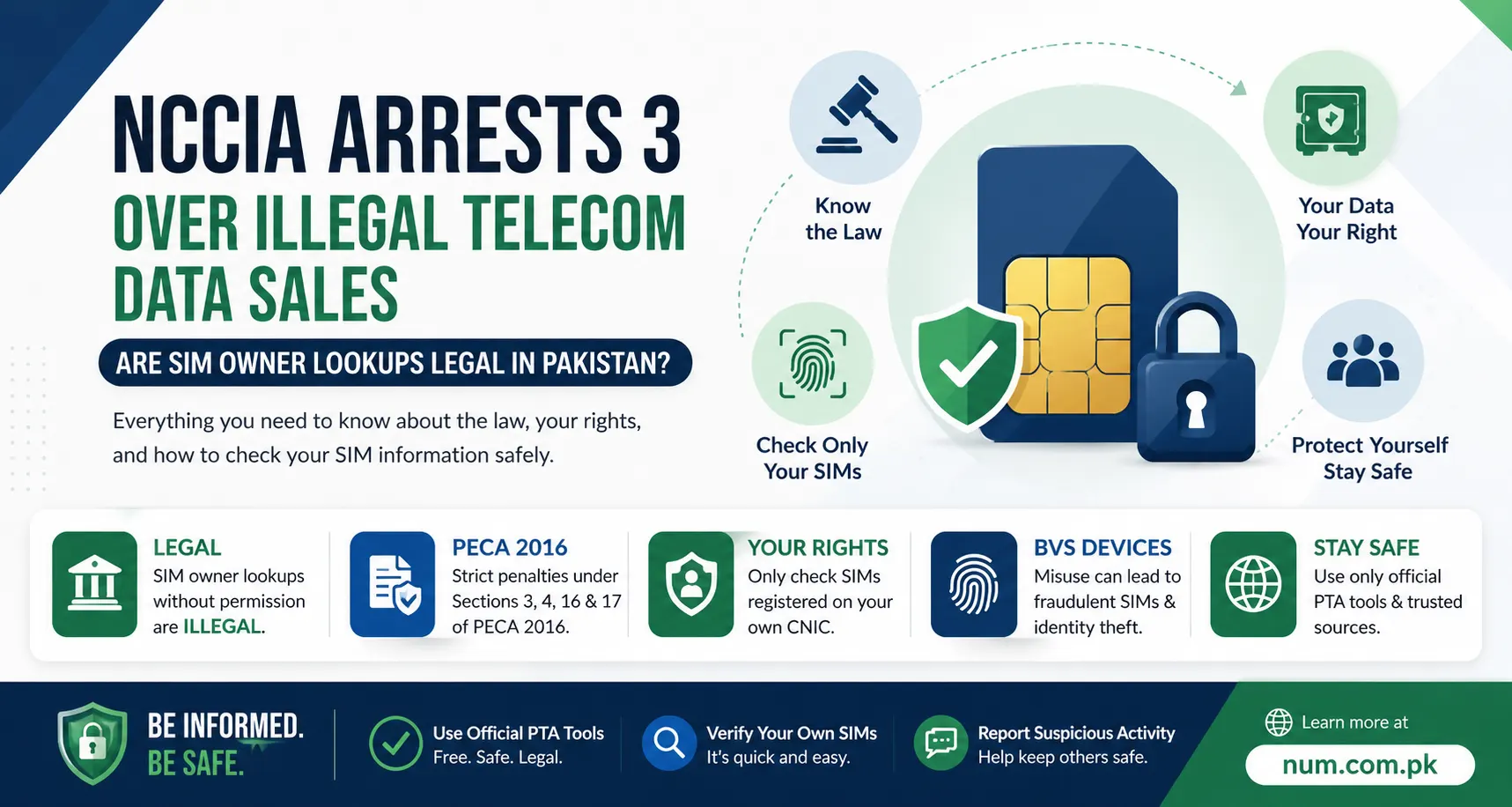
The Prevention of Electronic Crimes Act (PECA) 2016 is Pakistan’s primary cybercrime law and directly applies to this type of data misuse. Here are the relevant sections:
| PECA 2016 Section | What It Covers | Penalty |
| Section 3 | Unauthorized access to a system | Up to 3 months and/or a fine of Rs. 50,000 |
| Section 4 | Unauthorized copying or transmission of data | Up to 6 months and/or a fine of Rs. 100,000 |
| Section 16 | Unauthorized use of another person’s identity information (name, CNIC, number, etc.) | Up to 3 years and/or a fine of Rs. 5,000,000 |
| Section 17 | Unauthorized issuance of a SIM in someone else’s name | Up to 3 years and/or Rs. 500,000 fine |
Section 16 is the section most relevant to SIM owner lookups. It covers anyone who obtains, sells, or uses another person’s identity information without authorization — and this applies to the person searching for the information, not only the website or seller offering it.
Important correction: Some websites claim the penalty for this offence is “7 years imprisonment and Rs. 5.7 million.” This figure does not appear anywhere in the actual text of PECA 2016. Always rely on the verified penalties listed above.
Who Is Legally Allowed to Access SIM Owner Data
| Can Access Another Person’s SIM Data? | Allowed |
| PTA (regulatory authority) | ✅ Yes |
| NCCIA / police, with a valid investigation or court order | ✅ Yes |
| Telecom operators, for their own subscribers only | ✅ Yes |
| Private individuals, employers, journalists, or app/website operators | ❌ No |
Law enforcement agencies can request subscriber data from PTA and operators under Section 54 of the Pakistan Telecommunication (Re-organisation) Act 1996, but this process is only available through investigation channels, not to the general public.
The Only Legal Way to Check SIM Details in Pakistan
If you want to check how many SIMs are registered against your own CNIC, use only these PTA methods:
- SMS to 668: Send your 13-digit CNIC number (without dashes) to 668. You will get an operator-wise count of SIMs registered in your name. This costs a small SMS fee.
- Online portal: Visit cnic.sims.pk and enter your CNIC number and fill in the CAPTCHA for verification to see the same information for free.
- 667 service: Send a blank SMS to 667 from the SIM physically in your hand to confirm which CNIC that specific SIM is registered to.
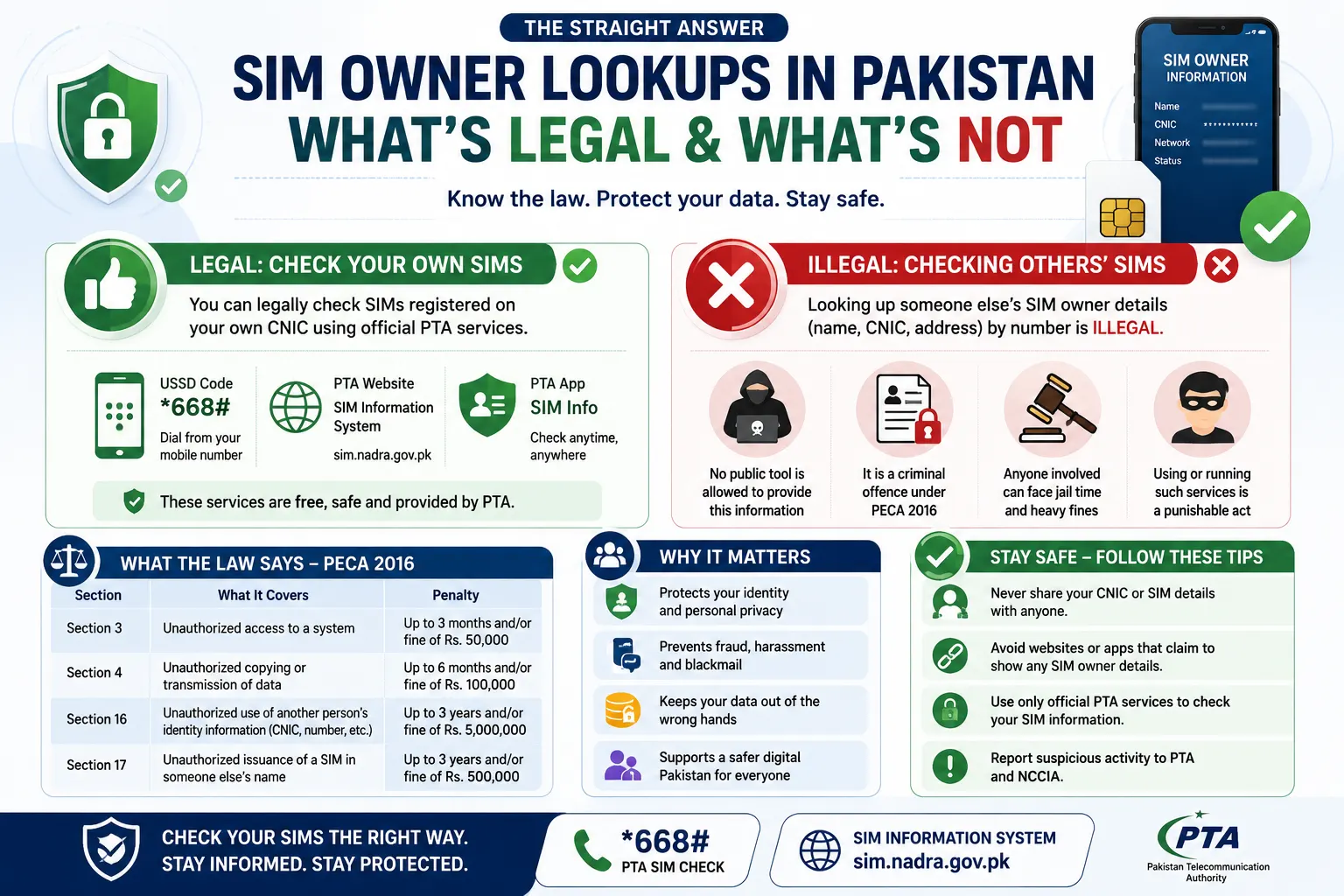
These services only return information tied to your own CNIC or your own SIM. No legal tool in Pakistan returns another person’s name, CNIC, or address just from typing in their mobile number.
Why Fake “SIM Database” Websites and Apps Are Dangerous
Since the NCCIA case shows that stolen telecom data is actively being sold, it’s worth understanding why “SIM owner details” websites and apps that claim to reveal a stranger’s identity from a phone number should never be trusted:
- They have no legal data source. PTA’s subscriber database has no public search window, so any site “returning” a name and CNIC from a number is either using stolen, leaked data, or simply making up a fake result.
- Using them is a criminal offence. Under PECA 2016 Section 16, the person searching is also legally exposed, not just the website operator.
- They often harvest your own data. Many of these sites collect the number or CNIC you type in and may misuse or resell it, adding you to the very kind of illegal data trade the NCCIA is investigating.
What To Do If You Suspect Your Data Was Leaked
If you believe your telecom or CNIC data has been exposed or misused:
- Check your own SIM registration immediately via 668 or cnic.sims.pk
- If you see an unfamiliar SIM registered on your CNIC, report it at your nearest telecom franchise to have it blocked or disowned.
- Report suspected data misuse to the NCCIA Cyber Helpline at 1799, or file a complaint through PTA’s Complaint Management System.
- Avoid entering your CNIC or phone number into any third-party “SIM checker” website that is not a PTA channel.
Conclusion
The NCCIA’s arrest of three suspects in Lahore is a clear reminder that the illegal trade of telecom subscriber data is a real and ongoing problem in Pakistan, and that PTA and NCCIA are actively taking legal action against it. For everyday users, the legal boundary is simple: checking SIM information tied to your own CNIC through 668 or cnic.sims.pk is completely legal and encouraged, while trying to look up another person’s identity from their phone number through any website or app is a criminal offence under PECA 2016 Section 16. Staying informed about cases like this, and sticking only to official PTA tools, is the safest way to protect your own identity while respecting the privacy of others.
Frequently Asked Questions
Is it legal to check someone’s SIM owner details in Pakistan?
No. Checking another person’s SIM owner details using only their phone number is illegal under PECA 2016 Section 16 and can lead to up to 3 years imprisonment and a fine of up to Rs. 5,000,000.
Can I legally check the SIMs registered on my own CNIC?
Yes. This is completely legal. Send your 13-digit CNIC as an SMS to 668, or for a free check, go to the online web portal.
What did the NCCIA arrest the three suspects for?
They were arrested for allegedly obtaining and selling telecom subscriber data, including call records, SIM ownership details, family registration information, and location data, following a complaint filed by PTA.
Are apps or websites that claim to show a stranger’s SIM owner details real?
No. There is no legal public tool in Pakistan that reveals another person’s name or CNIC from their phone number. Such websites either use stolen data or generate fake results.
What should I do if I find an unknown SIM registered on my CNIC?
Visit your nearest telecom franchise to have it blocked or disowned, and report it through PTA’s Complaint Management System if needed.
Where can I report illegal telecom data sales or a suspected data leak?
You can report it to the NCCIA Cyber Helpline at 1799, or file a complaint through PTA’s official Complaint Management System.
Disclaimer
The information provided on num.com.pk is for general informational and educational purposes only. We are an independent website and are not affiliated with, endorsed by, or officially connected with PTA, NADRA, or any mobile network operator in Pakistan. SIM, CNIC, mobile network, and telecommunications information may change over time, so users should verify important information through the relevant official or authorized sources. Our tools does not provide unauthorized access to private SIM databases, CNIC records, mobile-number ownership information, or live location data. We do not guarantee the completeness, accuracy, or current status of all information published on this website. By using our website, you acknowledge that you do so at your own discretion and risk.